
SBA Loan Refinance for an MCA: The 24-Month Path Under the Oct. 1, 2026 Rules
An SBA loan can pay off a merchant cash advance only after it becomes a term loan with 24 months of payments. Here is the path and what to ask.
Guide · · 6 min read
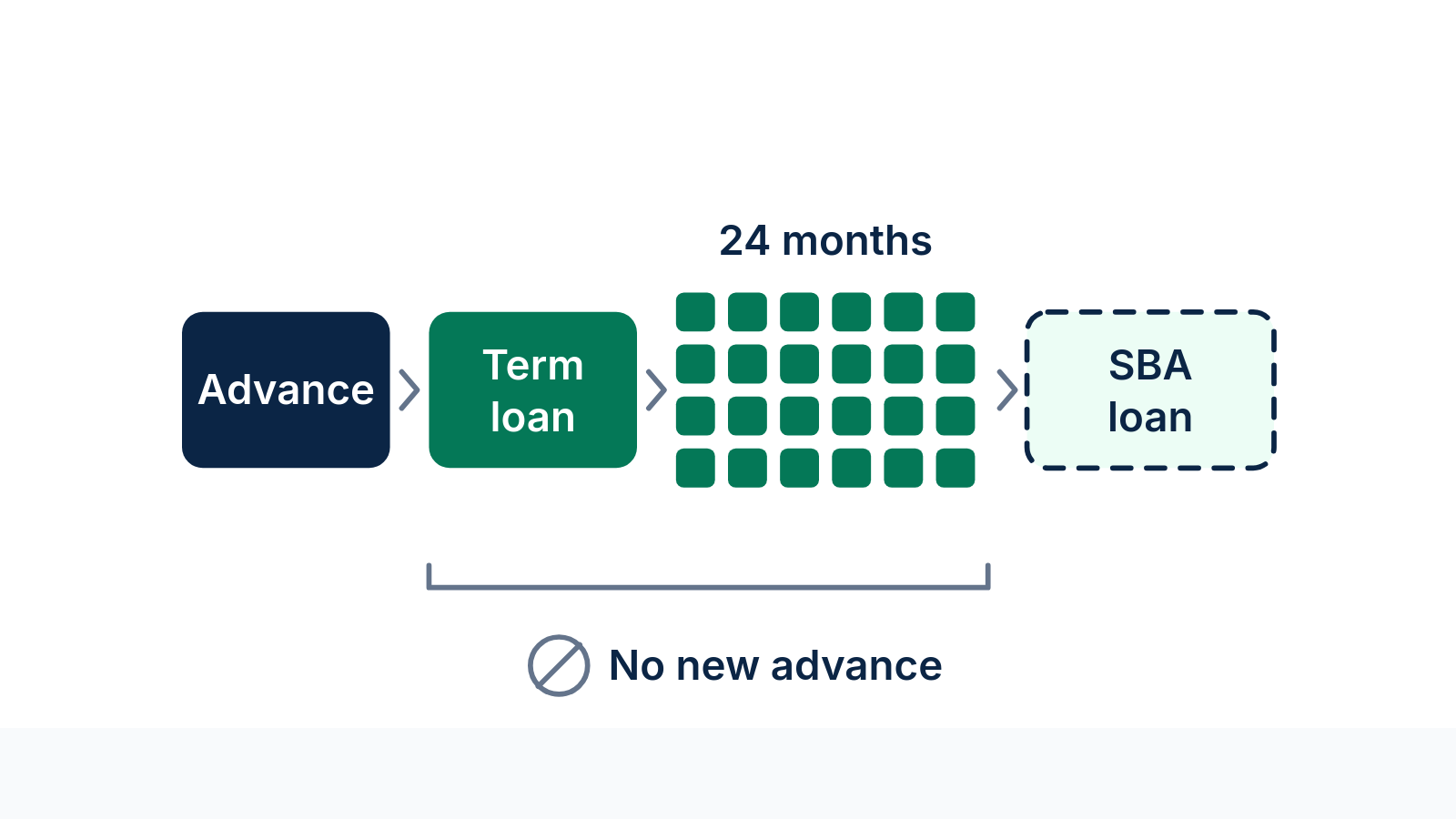
If you have a merchant cash advance and you’re wondering whether an SBA loan can take it over, the short answer is: not directly. An SBA lender can’t pay off an advance while it is still running. Under the SBA’s updated lending rules, effective October 1, 2026, there is a path, but it is long. The advance has to become a term loan first, and that term loan needs at least two years of payment history before an SBA refinance is even possible.
This guide covers how that path works, why it depends so heavily on your payment record, and what to ask before you sign anything.
How the rules got here
The SBA sets its rules for 7(a) and 504 lending in a document called SOP 50 10. The last two versions treated merchant cash advances very differently.
- June 1, 2025 to September 30, 2026 (SOP 50 10 8): MCAs and factoring agreements could not be refinanced with SBA loan proceeds at all. deBanked reported that the ban applied across Standard 7(a), 7(a) Small, SBA Express, Export Express and International Trade loans. The SBA had announced this version on April 21, 2025.
- From October 1, 2026 (SOP 50 10 8.1): the SBA now lists “Version 8.1 with Technical Updates” as the current SOP. It reopens refinancing for MCAs, but only under strict conditions.
The SBA’s term for an MCA is a “sales-based repayment agreement.” It describes this as an agreement where a business gets cash up front in exchange for a share of its future sales. That matches how MCAs are generally structured: as a purchase of future receivables, not a loan. Their legal treatment is still debated in some places.
The three conditions, in plain English
Under SOP 50 10 8.1, an advance can be refinanced with an SBA loan only if all three of these are true:
- It has been converted to a term loan. The original advance, with its holdback or fixed remittances tied to your sales, has to be replaced by a term loan with a set repayment schedule.
- That term loan has been paid down for at least 24 months. The SOP calls this amortizing: regular payments that reduce what you owe over time.
- You haven’t taken on any new agreements since the conversion. If you sign a fresh advance or a similar sales-based deal after converting, the debt no longer qualifies.
The SOP is blunt about advances that are still running: “If the Sales-Based Repayment Agreement is still active, it is not eligible for refinancing.”
The “current” rule: where your payment record comes in
Any debt an SBA loan refinances also has to be current, and the SOP defines that strictly:
- A payment counts as late once it has gone unpaid for more than 29 days.
- A loan that reached maturity and wasn’t paid off within 29 days is not current and can’t be refinanced.
- The debt has to be current now, and it has to have stayed current for the last 12 months, or for the entire life of the loan if that is shorter.
This is the credit-readiness part of the path. The SBA lender will look at how you handled the converted term loan. A clean record of on-time payments keeps you eligible. A run of late payments can disqualify the debt, no matter how long you have been paying.
What the path looks like on a calendar
Say you convert an advance near the end of 2026. Here is the rough order of events:
- Step 1: Conversion. Your funder or another lender turns the advance into a term loan. Make sure you get a clear document showing the conversion date and the repayment schedule.
- Step 2: 24 months of payments. You pay the term loan on schedule and avoid any new sales-based financing. Under the earliest reading of the rule, a conversion done today would reach the 24-month mark in late 2028.
- Step 3: SBA application. Only then can you ask an SBA lender to consider refinancing the term loan. Normal underwriting still applies.
One caution on step 3: eligibility is not approval. Meeting all three conditions just means the debt can be refinanced. The SBA lender still decides whether to approve the loan, and an SBA loan is not the right fit for every business.
Why a new advance can undo two years of work
The third condition is the easiest to break by accident. Cash gets tight halfway through the 24 months, a funder offers a quick new advance, and you take it. Under 8.1, a new agreement after the conversion makes the debt ineligible for SBA refinancing.
Before you sign anything during that window, including a renewal, a top-up or a “bridge,” ask whether it counts as an additional agreement. If nobody can answer clearly, treat it as a risk to your SBA plans.
Questions to ask your broker or funder before converting
Get these answers in writing:
- Will the conversion produce a document that counts as a term loan? You will need to show the SBA lender a real term loan with an amortization schedule, not a reworded advance.
- When does the 24-month clock start? Ask which date they will treat as the conversion date and what records will back it up.
- Does anything you’re offering me count as an “additional agreement”? This covers renewals, extra funding or any product tied to your sales.
- What will the converted term loan cost? Ask for the full cost in writing, using only the figures the offer discloses. A growing number of states require providers, and in some states brokers, to give commercial financing cost disclosures, including an estimated APR. Check current law in your state.
- How will my payments be recorded? You will need a record of on-time payments to show the debt stayed current.
What is still unclear
The 8.1 text answers a lot, but not everything. As of this writing, it is not yet confirmed:
- whether the 24 months must run from the conversion date, or whether every one of those payments must have been on time;
- whether factoring agreements get the same conditional path, or only sales-based agreements like MCAs;
- whether the rule applies to 504 debt refinancing as well as 7(a);
- what payment-improvement or “unreasonable terms” test, if any, applies to 7(a) debt refinancing under 8.1. Some industry commentary describes such a test, but we could not confirm it in the current SOP text, so don’t plan around a specific figure.
We’ll update this guide as those points are clarified.
If the SBA path doesn’t fit
The SBA rule is not the only route. Advisor commentary notes that a regular bank loan without an SBA guarantee can still refinance MCA balances if the bank chooses to. That usually comes with stricter underwriting. Treat this as a general observation, not a rule, and compare any offer on its disclosed terms. To see other options grouped by what you need, browse our funding options.
Business credit takeaways
- Your payment habits are your application. The current rule looks back 12 months, so on-time payments on the converted loan matter most.
- Plan your cash so you don’t need new funding mid-path. A new sales-based agreement after conversion takes the SBA route off the table.
- Keep a paper trail. Save conversion documents, the repayment schedule and payment confirmations.
- Build credit alongside the plan. Our Business Credit 101 steps cover the basics while you work toward eligibility.
Sources
- U.S. Small Business Administration, SOP 50 10: Lender and Development Company Loan Programs (version 8, effective June 1, 2025; version 8.1, effective October 1, 2026): https://legacy.sba.gov/document/sop-50-10-lender-development-company-loan-programs
- deBanked, “How to Pay Off an MCA With an SBA Under the New Rules Effective Oct 1”, September 23, 2026: https://debanked.com/2026/09/how-to-pay-off-an-mca-with-an-sba-under-the-new-rules-effective-oct-1/
- deBanked, “SBA Places Restrictions on Use of Proceeds to Refinance Merchant Cash Advances and Factoring Agreements”, about April 22, 2025: https://debanked.com/2025/04/sba-places-restrictions-on-use-of-proceeds-to-refinance-merchant-cash-advances-and-factoring-agreements/
- Grasshopper Bank, “New SBA SOP: What You Need to Know About 50 10 8”, indexed about March 2026: https://www.grasshopper.bank/who-we-are/blog/new-sba-sop-what-you-need-to-know-about-50-10-8/
- Renaissance Capital Advisors, SBA MCA refinancing commentary, about May 2026: https://rencapadvisors.com/insights/sba-mca-refinancing-closed.html
About the author
The Credisian Editorial Team writes plain-English guides and news on business credit and borrowing, sourced and checked under our editorial policy, to help owners make informed funding decisions.