
Merchant Cash Advance Fees: What to Ask About Before You Sign
Compare merchant cash advance fees using one dated agreement: net funds, deductions, remittance and reconciliation questions to ask before signing.
Guide · · Updated Oct 26, 2026 · 6 min read
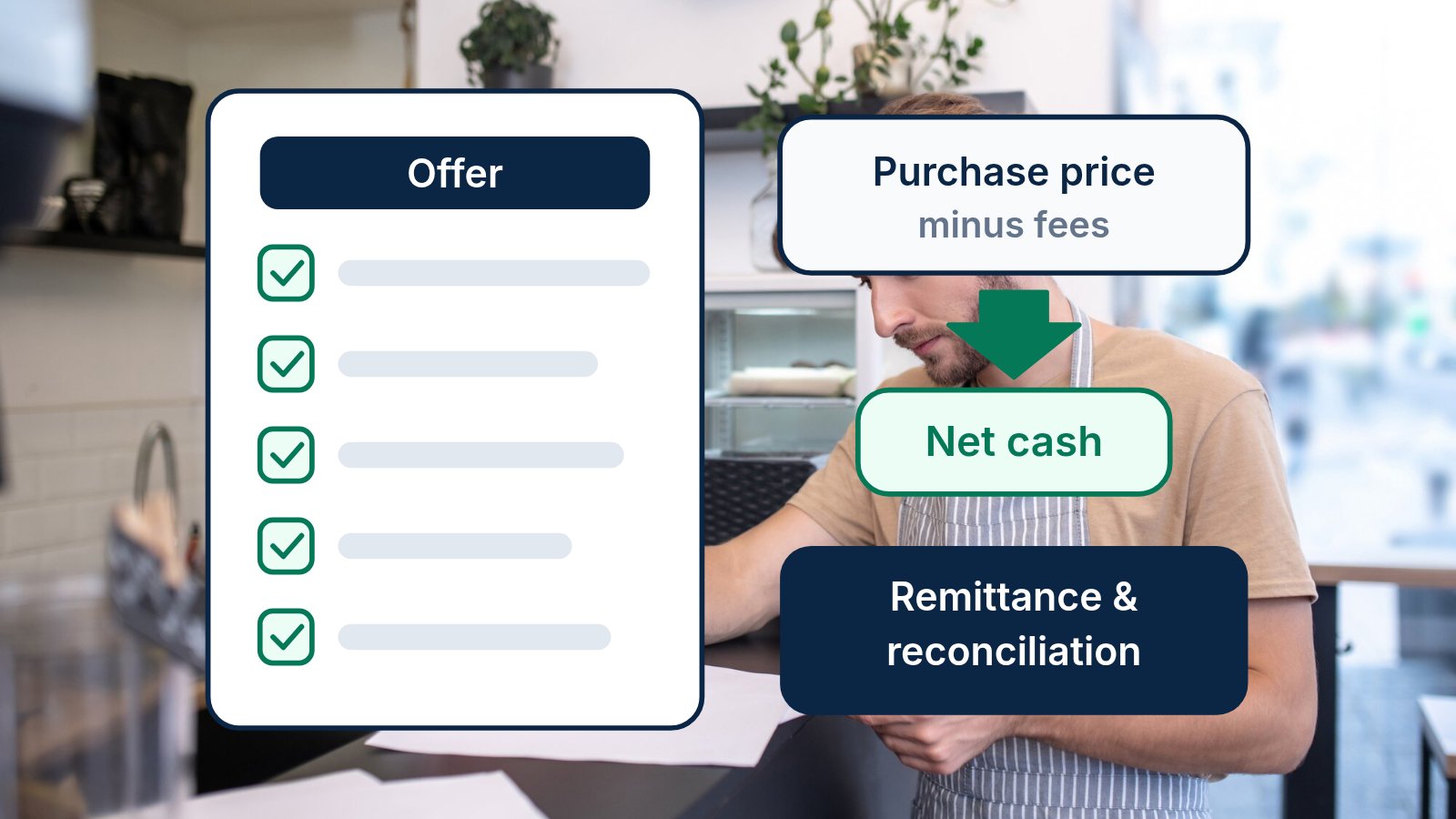
Merchant cash advance fees occupy several dollar fields in the agreement examined here. Use those fields as a checklist when asking for the costs of your own offer. A merchant cash advance is structured as a purchase of future receivables, so the paperwork talks about what was bought, what you were paid and what gets taken out along the way.
This guide reads one real contract for its dollar fields and turns each into questions for the offer on your desk. It is a checklist, not a ranking, and it says nothing about what any provider charges today.
Updated October 26, 2026, to work from a contract dated April 1, 2025. The August 22, 2024 publication date is editorial; the contract came later.
The example, and its limits
The contract is a single Arin Funding agreement dated April 1, 2025 (see Sources), made with a company and several affiliated merchants. Whenever this guide says “this agreement”, it means that document alone. It is not a typical contract, a current offer or evidence of how any provider operates, and your offer may be worded differently. Treat each clause as a prompt for a question, not as something you are owed.
Four topics are in scope: net cash against purchase price, fee lines, how payments are collected and how a reconciliation gets requested. If you came looking for merchant cash advance rates, note that this form has no factor-rate field, and the guide does not convert any figure in it into a rate.
What reaches your account
The first page of this agreement uses separate fields for money that other documents might blur together.
| Field label | Plain meaning in this agreement |
|---|---|
| Purchase Price | What the provider pays for the receivables it buys |
| Receivables Purchased Amount | The total of receivables being sold |
| Net Funds Provided | The price once the applicable section 2 fees are taken out |
| Net Amount to Be Received Directly by Merchant(s) | What lands with the merchants after those fees and after any slice of the price that an addendum sends to someone else |
The layout makes a point worth carrying over. Cash in hand can sit well under the Purchase Price, and differ again from the receivables total. Fees explain part of the gap, and paying off an earlier position explains another part. The form even states that the direct figure moves if the amount owed on that other obligation changes.
Questions for any offer:
- How much will actually arrive in my account, and how far is that from the purchase price and from the total I will remit?
- Which fees come out before the money moves?
- If part of the funds pays off an earlier advance or other obligation, how much is it, and who confirms the figure?
If an earlier balance is in the picture, SBA refinancing of MCA balances is covered separately.
Fee lines, sorted three ways
Section 2 lists seven fee lines and says they come on top of the purchased receivables total, where applicable. The agreement does not group them. This guide does, to make them easier to question.
Taken before funding
- A charge for underwriting, the ACH debit program and setting up the transactions.
- A wire charge that depends on whether the money moves by Fed Wire or bank ACH.
- A legal-compliance line for disclosure rules, left without an amount on this form.
Charged when something happens
- A charge for each returned or rejected debit. The clause excuses the merchant if it warns the provider, at most one business day ahead, that the account will be short, and it is not otherwise in default.
- A blocked-account or default charge after an Event of Default.
- A UCC-1 filing charge, and a separate one if a filing is terminated.
Open-ended
- The provider’s costs of enforcing its rights: court, arbitration, collection agency, attorneys and experts. No amount is stated.
Whether a line applies depends on the contract, so an empty one is worth asking about. Default can also trigger sums outside section 2. This agreement has separate clauses on the whole unpaid balance falling due, a liquidated-damages election and attorney fees.
Questions for any offer:
- Which fees in my offer are fixed, which are triggered by an event and which are open-ended?
- What does each blank or “where applicable” line mean for me?
How the provider collects
Section 1 has the merchant authorize ACH debits of a set percentage of receipts, plus any applicable fees, from one deposit account each day, starting the business day after signing. Section 3 gives the provider an alternative: a fixed weekly Estimated Payment, which the text calls an approximation of no more than that percentage and subject to reconciliation. The agreement leaves the choice between the two to the provider.
Two other clauses affect cash flow. This agreement makes the merchant carry the fees from a rejected debit or a default, while it says the provider is not responsible for overdrafts and rejected transactions its debits cause. It also calls the term “indefinite,” continuing until the provider has received the full purchased total, with no fixed end date.
Questions for any offer:
- Is collection a daily percentage or a fixed weekly sum, and who picks?
- What happens if my sales dip below the weekly figure?
- Is the term fixed, and what must be paid for it to end?
Asking for a reconciliation
Section 4 is this agreement’s answer to a practical worry: what if the debits do not match my sales? A merchant may write or e-mail the provider’s Reconciliation Department and ask it to check that collections equal the agreed percentage of receipts. The request goes with bank statements from signing to the request date, plus month-to-date account reports, other revenue documents or, where available, the account login.
Once a proper request arrives, the agreement commits the provider to tell its ACH processor to pause debits until the check is done, and to finish within two business days of receiving the request and documents. It also commits the provider to credit any excess to the account and lower the weekly estimate, or to debit any shortfall and raise it. The job of starting a reconciliation rests on the merchant that wants one, and nothing limits how often one can be requested. The provider may also reconcile on its own at any time. The agreement says each merchant then gets written notice of the result within one business day of completion.
A contract’s text is not proof of what happens in practice, so ask about each step.
- How do I request a reconciliation, and which records do I send?
- How long does the provider have, and do debits stop meanwhile?
- Can the weekly estimate differ from my actual receipts, and how is the difference settled?
Broker fees
If a broker or independent sales organization brought you the offer, section 46 treats it separately. This agreement states that a broker is not the provider’s agent or representative, that the provider is not bound by promises a broker makes outside the written agreement, and that a broker’s fee is separate from payments under it. It also says the provider does not require a broker or its fee.
So ask three things. Is there a broker fee? Is it shown apart from the provider’s own fee lines? Is every assurance you are counting on written into the agreement itself?
Lining offers up
To compare merchant cash advance offers, collect the same items from each one in writing: net cash and any payoff amount, purchase price and total to remit, every fee by group, any broker fee, the collection method, the reconciliation steps and the term. Until an offer supplies all of them, it cannot be compared fairly. Then set the answers side by side in dollars.
Still choosing a product? Alternative funding for small business compares the main options, and MCA funding options collects the guides on this one. If an application was turned down, see next steps after a denial.
A note on cost disclosures
A growing number of states require commercial financing cost disclosures, including an estimated APR, from providers and, in some states, brokers. An APR quoted in an offer is the provider’s disclosed estimate, so do not recompute it from contract figures. Rules change, so check current law before relying on a disclosure. For how market rates affect other financing, see rising rates and business financing.
Sources
- Arin Funding LLC, Standard Merchant Cash Advance Agreement, dated April 1, 2025, with Edible Garden AG Incorporated and affiliated merchants, SEC exhibit EX-10.1 (archived copy).
About the author
The Credisian Editorial Team writes plain-English guides and news on business credit and borrowing, sourced and checked under our editorial policy, to help owners make informed funding decisions.